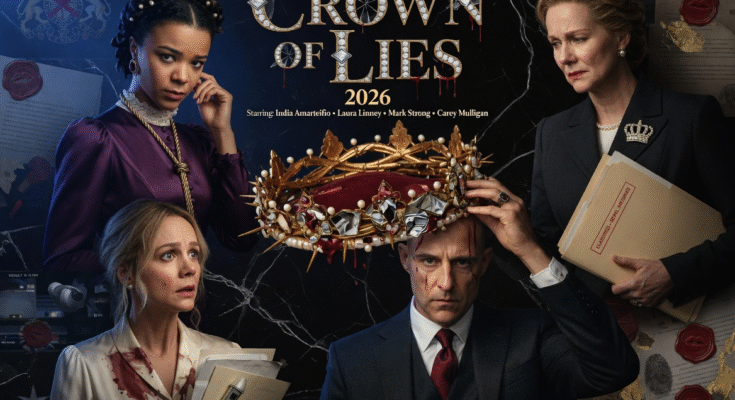
There are stories about kingdoms, and then there are stories about the people slowly destroyed by them. Crown of Lies is not interested in fairy tales or heroic legends. It walks directly into the darkness behind palace walls, where loyalty becomes currency, love becomes strategy, and truth is the first sacrifice made for power. What begins as a political drama quietly transforms into something far more haunting — a portrait of ambition consuming every soul it touches.
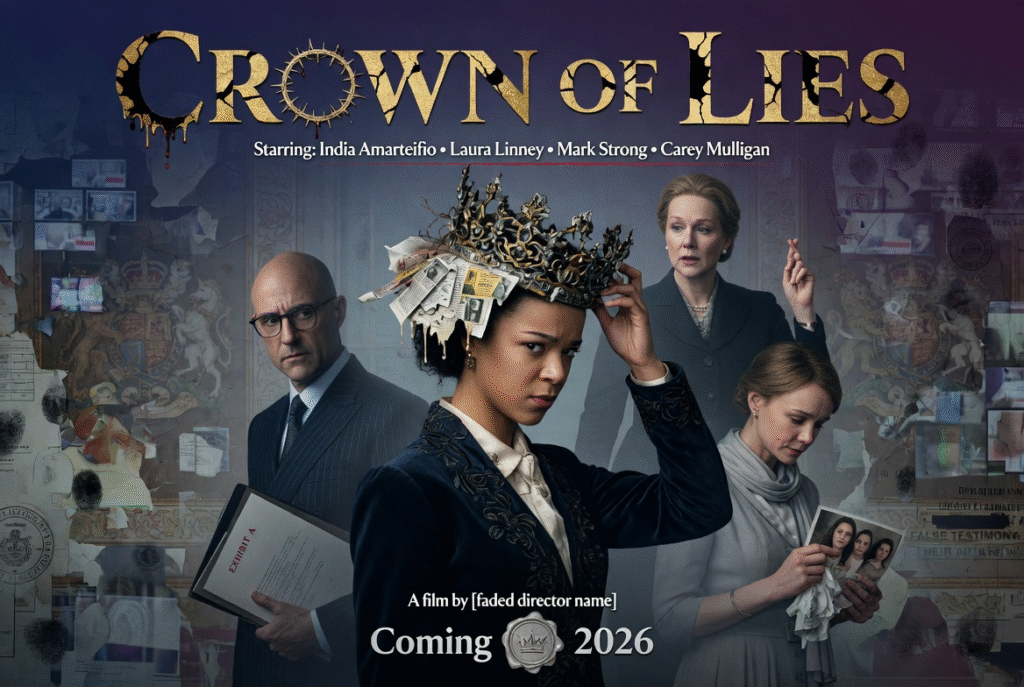
India Amarteifio delivers a mesmerizing performance as the young royal heir trapped between duty and identity. She doesn’t play the role with the elegance audiences might expect from a traditional queen-in-the-making. Instead, she carries an exhaustion in her eyes, as if every conversation is already a battlefield she knows she cannot survive. Her performance feels painfully human, and that vulnerability becomes the emotional heartbeat of the film.
Laura Linney is terrifying in the most subtle way possible. She never raises her voice unnecessarily, never forces dominance through obvious cruelty, yet every scene she enters suddenly feels colder. Her character understands that fear does not come from violence alone — it comes from silence, manipulation, and the ability to make others doubt themselves. Linney turns every line into a weapon hidden behind royal etiquette.
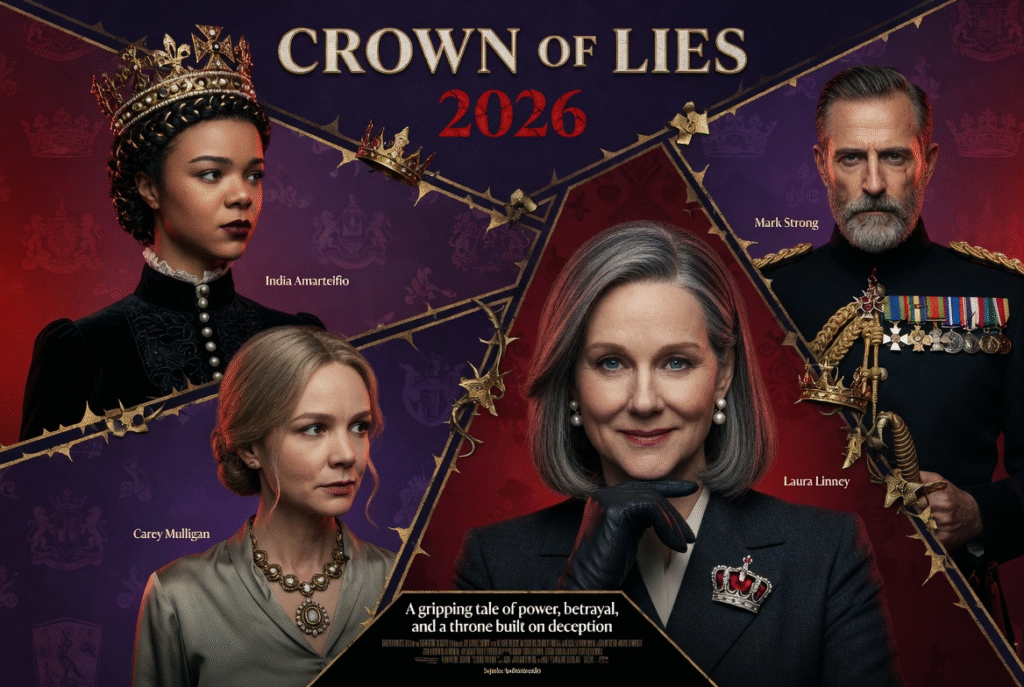
Mark Strong once again proves why he remains one of cinema’s most underrated forces. His presence in Crown of Lies feels like a shadow standing in the corner of every decision. He plays a man who has spent his entire life protecting a system he secretly despises, and that internal war slowly tears him apart. Strong gives the film its moral weight, embodying the tragedy of men who mistake obedience for honor.
Then there is Carey Mulligan, whose performance quietly steals the entire film. She plays her role with heartbreaking restraint, allowing emotion to exist beneath every glance rather than through dramatic speeches. Some of the film’s most devastating moments happen when she says absolutely nothing. Mulligan understands that grief is often silent, and her silence echoes throughout the story like a ghost haunting the palace halls.
Visually, the film is breathtaking without ever feeling glamorous. The cinematography avoids turning royalty into fantasy. Candlelit corridors, cold marble chambers, rain-covered balconies — every frame feels trapped between beauty and decay. The palace itself becomes a prison disguised as luxury, a place where nobody truly sleeps because everyone is terrified of losing control.
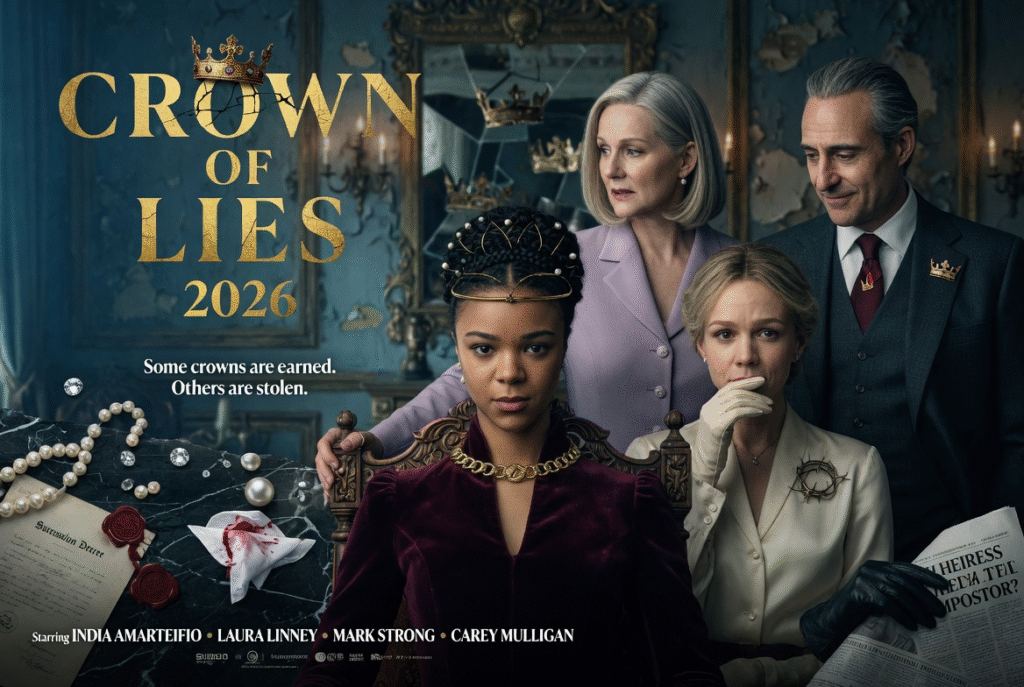
What makes Crown of Lies so compelling is the way it treats deception not as villainy, but as survival. Nearly every character lies, yet the film refuses to judge them easily. In this world, honesty is dangerous. Trust is temporary. Even love must negotiate with power before it can exist. The script constantly asks one painful question: can someone remain good while fighting to survive inside a corrupt system?
The pacing is deliberate, almost hypnotic. This is not a film driven by explosions or shocking twists every few minutes. Instead, tension builds slowly through conversations, glances, and political maneuvering. Every dinner scene feels more dangerous than a battlefield because the real weapons are secrets. The film understands that emotional warfare can be far more brutal than physical violence.
One of the most impressive aspects of Crown of Lies is how modern it feels despite its royal setting. Beneath the crowns and ceremonies lies a sharp commentary about public image, inherited power, media manipulation, and the loneliness of leadership. The characters are constantly performing versions of themselves for the public, slowly forgetting who they really are underneath the masks they wear.
The soundtrack deserves enormous praise for its restraint. Rather than overwhelming scenes with dramatic orchestration, the music often lingers quietly in the background like an approaching storm. This choice allows the performances to breathe, making emotional moments hit with devastating precision. Some scenes become almost unbearably tense simply because the silence feels heavier than sound.
By the time the final scene arrives, Crown of Lies leaves behind more than tragedy — it leaves a question. Was the crown ever worth wearing at all? The film offers no comforting answers, only the unsettling realization that power rarely corrupts instantly. Sometimes it happens slowly, one compromise at a time, until the person staring back in the mirror becomes unrecognizable. And that is what makes Crown of Lies linger long after the credits fade to black.
