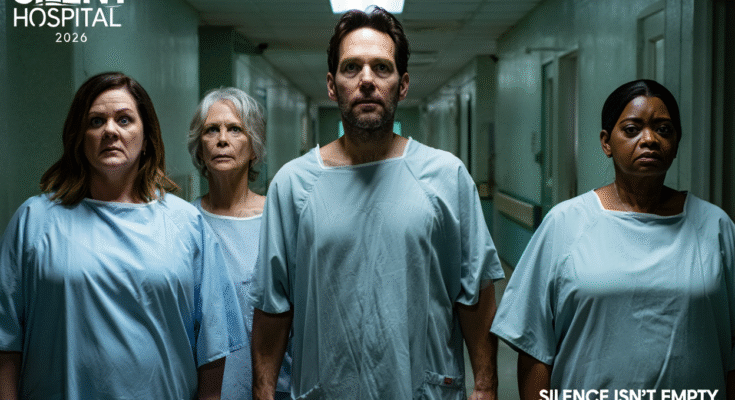
In the chilling landscape of 2026’s cinema, Silent Hospital emerges not just as a film, but as a sensory deprivation experiment that redefines the boundaries of psychological horror. Directorially, the film understands a fundamental truth that many modern jump-scare factories forget: that the human ear, when denied sound, begins to manufacture its own madness. From the opening shot of the sun-bleached, sterile corridors of St. Jude’s, the audience is plunged into a world where the air feels heavy with unspoken secrets. This is a space where the clatter of a fallen tray carries the weight of a gunshot and where the hum of fluorescent lighting becomes a predatory growl.
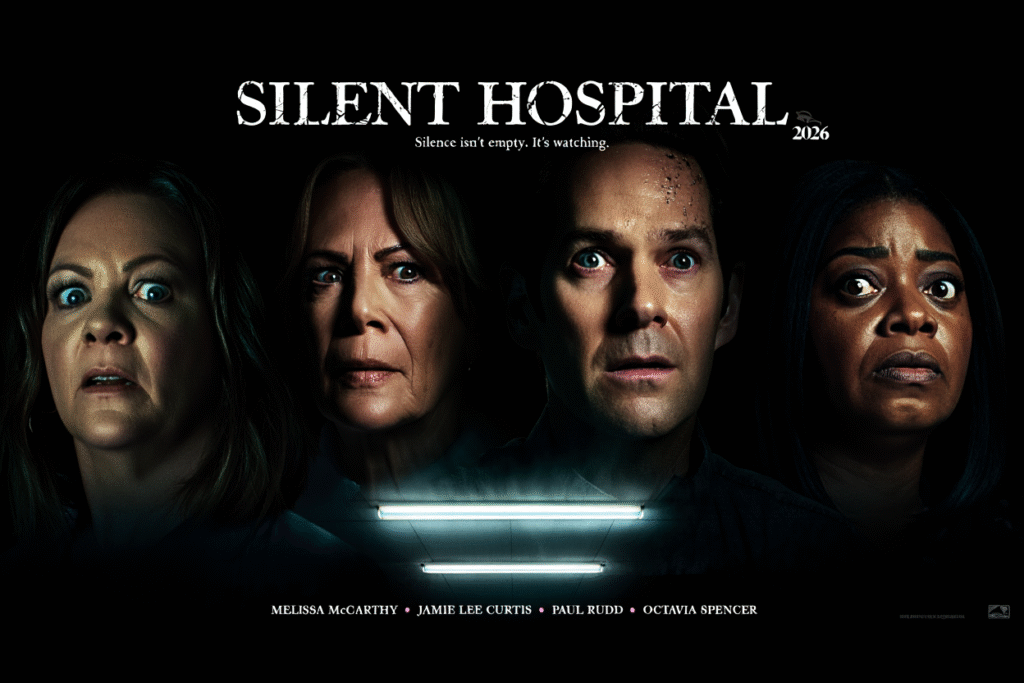
The casting is a stroke of subversive genius, pitting actors we traditionally trust for comfort against a backdrop of existential dread. Melissa McCarthy delivers a career-defining performance, shedding her usual comedic armor to play a woman paralyzed by a grief so profound it has robbed her of her voice. There is a raw, vibrating vulnerability in her eyes that communicates more than a monologue ever could, grounding the film’s supernatural elements in a very human tragedy. She navigates the hospital’s labyrinthine hallways not as a hero, but as a survivor, her every breath a frantic prayer against the encroaching stillness.
Opposite her, Jamie Lee Curtis provides a masterclass in controlled ambiguity as the head administrator, a woman whose smile never quite reaches her eyes. Curtis utilizes her “scream queen” lineage to subvert expectations; she doesn’t scream, she whispers—or worse, she stares in a way that suggests she knows exactly why the walls are hungry. Her presence adds a layer of institutional horror to the supernatural, hinting that the hospital’s silence isn’t a symptom of a haunting, but a strictly enforced policy. It is a chilling reminder that sometimes the most terrifying monsters are the ones wearing white coats and carrying clipboards.
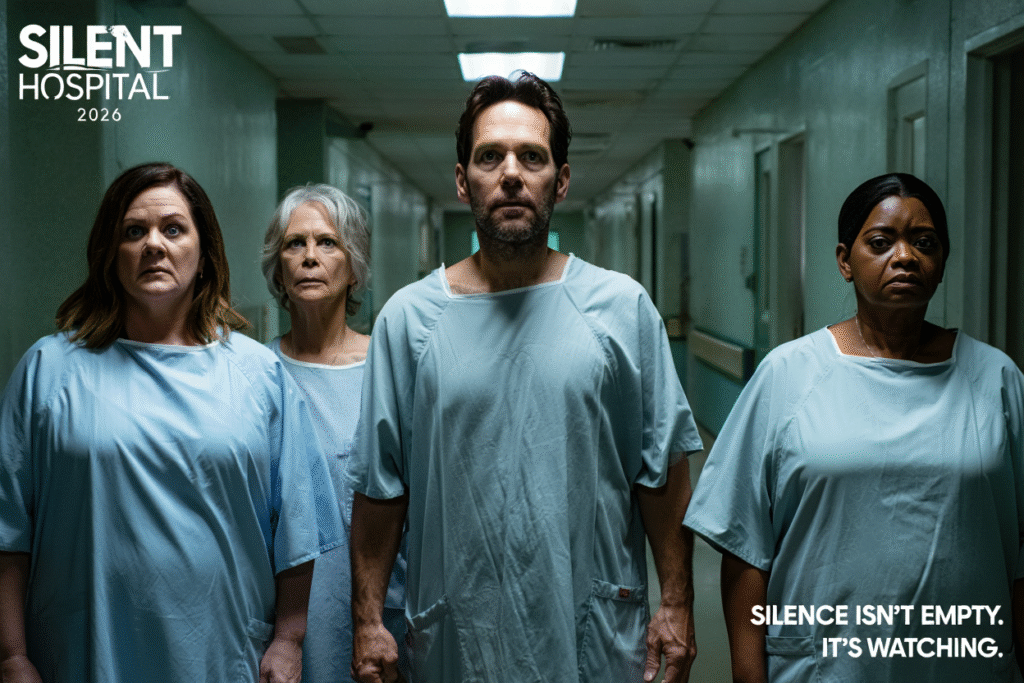
Paul Rudd, often the “everyman” we look to for a sense of normalcy, is utilized here to devastating effect as a doctor losing his grip on the clinical reality he once championed. Rudd’s descent into paranoia provides the film’s intellectual engine, as he tries to quantify a phenomenon that defies the laws of physics. His performance is a slow-motion car crash of the psyche, moving from skepticism to a wide-eyed, frantic realization that the silence is a sentient force. Watching a performer of his natural charisma wither under the pressure of the “unheard” is perhaps the film’s most unsettling achievement.
Octavia Spencer rounds out this formidable quartet, bringing a grounded, spiritual gravitas to the role of a long-term patient who has learned the “language” of the hospital. Spencer acts as the film’s prophetic soul, using sign language and intense physical presence to warn the others of the “watching” silence. There is a sequence involving her in a darkened ward that stands as one of the most tense moments in horror history, relying entirely on the rhythm of her movements and the terror reflected in her pupils. She represents the bridge between the logical world and the nightmare reality that St. Jude’s has become.
The film’s tagline, “Silence isn’t empty. It’s watching,” is executed with terrifying literalism through the cinematography, which treats negative space like a character. Every empty doorway and shadow-drenched corner feels inhabited, as if the silence itself is a predatory mist waiting for a sound to feast upon. The camera often lingers just a second too long on a vacant chair or a still curtain, forcing the viewer’s brain to fill in the gaps with their own worst fears. It is a visual manifestation of the “creeping realization” promised in the trailer, a slow-burn tension that never offers the release of a scream.
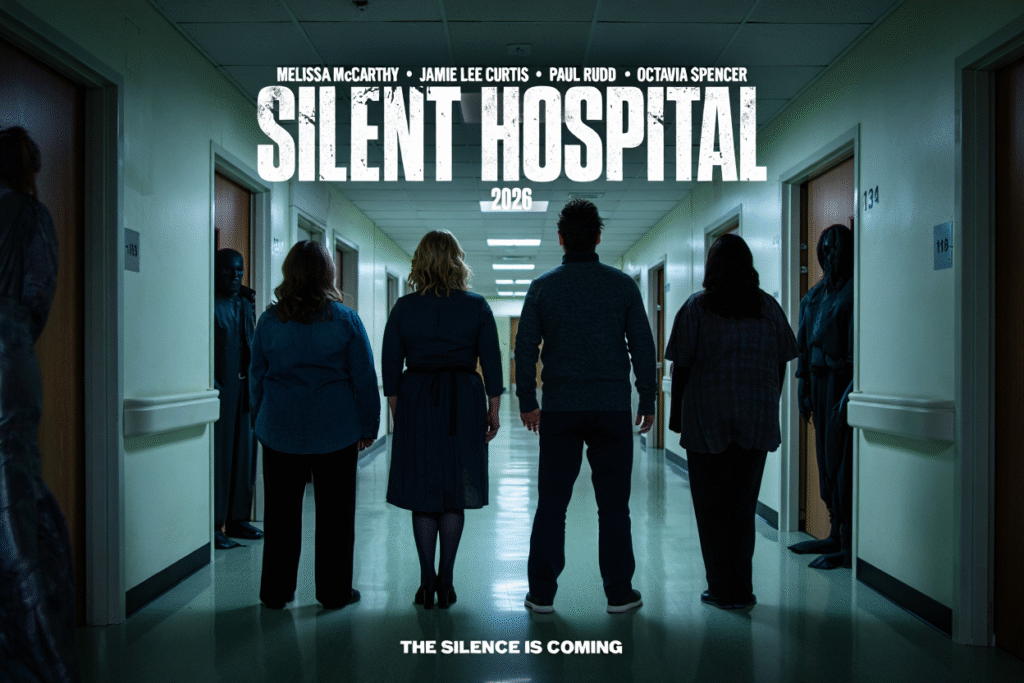
Sound design—or rather, the deliberate absence of it—is the film’s true antagonist, used with a surgical precision that makes the theater feel claustrophobic. When sound does occur, it is distorted and alien; the squeak of a sneaker on linoleum is amplified into a piercing shriek, and the drip of an IV bag becomes a rhythmic, maddening countdown. The film’s foley artists have created a sonic landscape where every vibration feels like an intrusion, making the audience hyper-aware of their own breathing and the rustle of their seats. This auditory intimacy creates a shared vulnerability between the characters and the spectators that is rarely achieved in the genre.
Thematically, Silent Hospital explores the terrifying notion that our voices are our only tether to reality, and once they are stripped away, we are defenseless. It taps into a primal fear of being unheard, of screaming into a void and having the void simply stare back. The “elevated horror” label fits perfectly here, as the film uses its supernatural premise to comment on the ways we silence ourselves in the face of institutional rot and personal trauma. It suggests that the hospital isn’t just haunted by ghosts, but by the echoes of everything its inhabitants were too afraid to say out loud.
As the plot spirals toward its final act, the slow-burn tension ignites into a frantic struggle for survival that remains, remarkably, almost entirely quiet. The “quiet” scares are far more effective than any loud bang; a hand slowly sliding over a mouth, a door closing without a click, a shadow that moves when its owner stays still. The film refuses to give the audience the easy out of a traditional climax, opting instead for a haunting, cerebral conclusion that lingers in the mind like a ringing in the ears. It is a bold choice that honors the film’s atmospheric integrity, ensuring that the dread follows you out of the cinema.
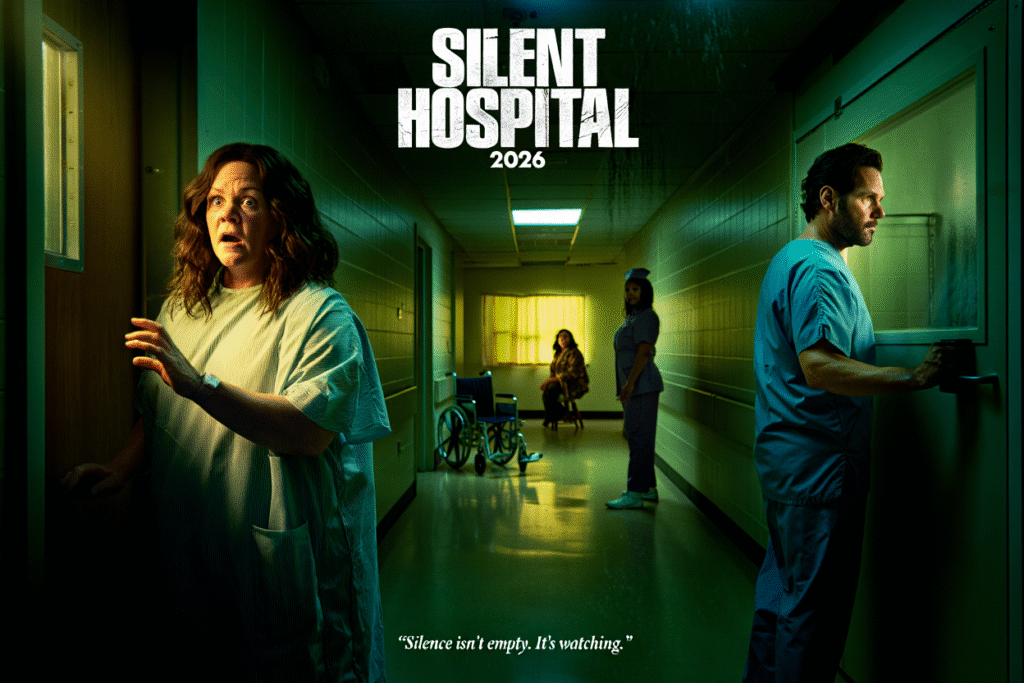
Silent Hospital is a landmark achievement in horror because it trusts the power of the unspoken, allowing the audience’s imagination to do the heavy lifting. It proves that McCarthy, Curtis, Rudd, and Spencer are a powerhouse ensemble capable of carrying a film on their expressions alone, creating a tapestry of fear that is as beautiful as it is horrific. This isn’t a movie you simply watch; it is a movie you endure, its stillness seeping into your bones until you find yourself holding your breath in the dark. It is a chilling reminder that in a world of constant noise, the most terrifying thing of all is the moment the sound stops.
The legacy of the film will undoubtedly be its ability to turn the mundane architecture of a hospital into a nightmare of the mind. By the time the final frame fades to black, the “creeping realization” has become an absolute certainty: the silence is no longer coming—it is already here, and it has no intention of letting you go. We leave the theater not just shaken by the images on screen, but suspicious of the very air around us. Silent Hospital is a masterpiece of atmospheric dread, a film that teaches us to fear the quiet and to never, ever underestimate the power of what is left unsaid.
