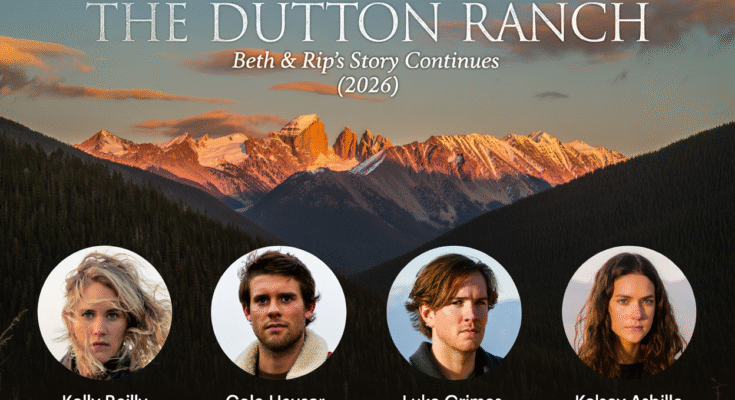
Some love stories are soft. This one is made of scars, loyalty, and a promise that never needed words. The Dutton Ranch: Beth & Rip’s Story Continues (2026) steps back into a world where survival is not guaranteed and love is not gentle — it is earned. With Kelly Reilly and Cole Hauser at the center, supported by Luke Grimes and Kelsey Asbille, the story feels like a continuation of something raw, unfinished, and deeply personal.
Beth Dutton has never been a character who compromises. She does not forgive easily, does not forget anything, and does not believe the world owes her kindness. But beneath the anger is someone who has always been fighting to protect the only thing she truly loves — her family, and more specifically, Rip.
Rip Wheeler, on the other hand, has always been steady where Beth is chaos. Loyal to a fault, shaped by a brutal past, and defined by the ranch itself, Rip is not just a partner — he is a man who has built his entire identity around protecting something that may not survive the modern world.
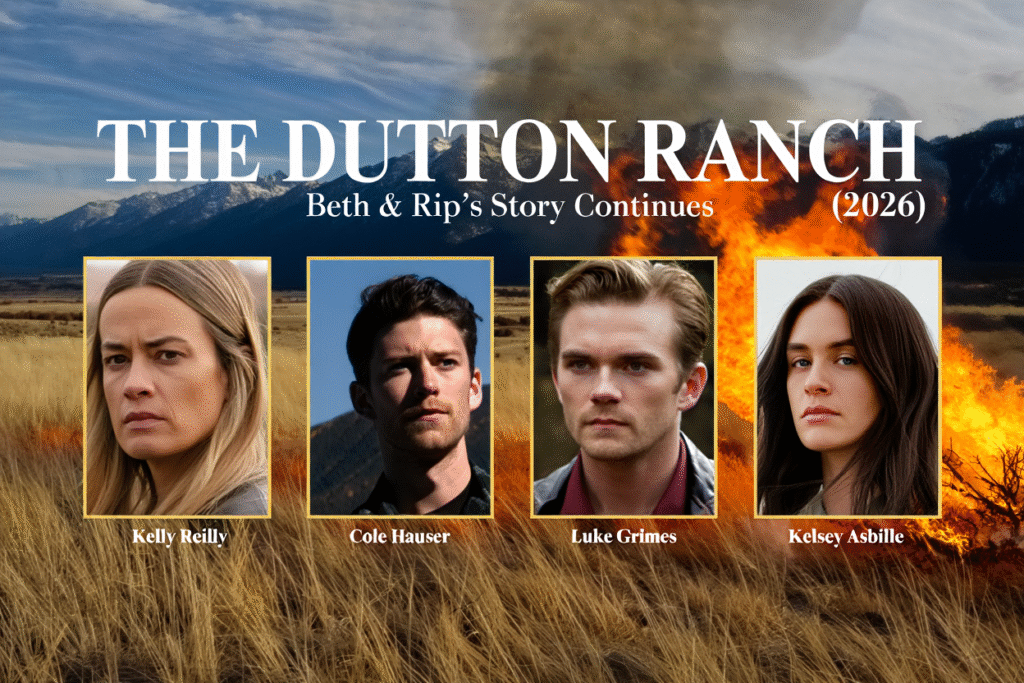
This continuation feels like it wants to strip everything back. The power games, political wars, and outside enemies may still exist, but the real conflict is now internal. What happens when the fight is no longer against outsiders, but against time, change, and the weight of everything they have been through?
Luke Grimes’ Kayce represents that tension perfectly. He has always stood between two worlds — the Dutton legacy and something quieter, more peaceful. His presence reminds the story that there is always another way to live, even if it feels impossible to choose it.
Kelsey Asbille adds emotional depth as Monica, grounding the story in consequences. She has seen what the ranch takes from people, and she understands that survival often comes at a cost that cannot be undone. Her perspective brings balance to a world that is constantly on the edge of violence.
Visually, the series would continue to capture the breathtaking beauty of the American West — wide-open skies, endless land, horses moving through dust at sunrise. But there is always a contrast: beauty on the surface, danger underneath. The land is stunning, but it demands everything in return.
Thematically, this chapter feels like it is about legacy. Not just what the Duttons leave behind, but whether that legacy is worth protecting anymore. The ranch has always been a symbol of power, but it is also a burden — something that traps people just as much as it defines them.
Beth and Rip’s relationship remains the emotional core. It is not romantic in a traditional sense. It is intense, sometimes destructive, but undeniably real. They understand each other in ways no one else can, and that connection becomes both their strength and their weakness.
There is also a growing sense that the world is changing faster than they are. The old rules no longer apply. The land is no longer safe. And the idea of holding onto everything at any cost may finally start to crack.
As the story builds, the tension becomes less about who will win and more about what will be left when the fight is over. That shift makes the story feel heavier, more reflective, and more emotional.
By the end, The Dutton Ranch: Beth & Rip’s Story Continues (2026) would not just be about survival — it would be about choice.
Because sometimes, the hardest thing is not holding on.
It is deciding whether to finally let go.
