There are disaster films, and then there are films that take disaster and mutate it into something far more primal, far more intimate—and Thrash belongs firmly in the latter. Exploding onto Netflix with ferocious intensity, this survival thriller doesn’t just depict nature’s fury; it weaponizes it, turning the aftermath of a Category 5 hurricane into a suffocating, relentless nightmare where the ocean itself becomes a living predator.
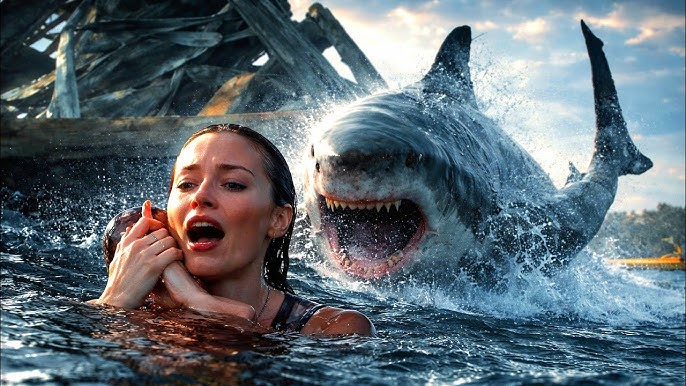
From its opening moments, Thrash establishes a haunting sense of inevitability. The storm arrives not as spectacle, but as a force of erasure—tearing apart homes, swallowing streets, and reducing a quiet coastal town into fragments of memory. But just when the audience believes the worst has passed, the film pivots sharply into horror. The floodwaters do not recede—they rise, and with them, something ancient, silent, and deadly.
What makes Thrash so effective is its refusal to give the viewer a moment of safety. There is no calm after the storm, no reassuring pause. Instead, every submerged street becomes a corridor of dread, every shadow beneath the water a potential death sentence. The sharks are not just creatures here—they are extensions of the chaos, symbols of a world that has completely slipped out of human control.
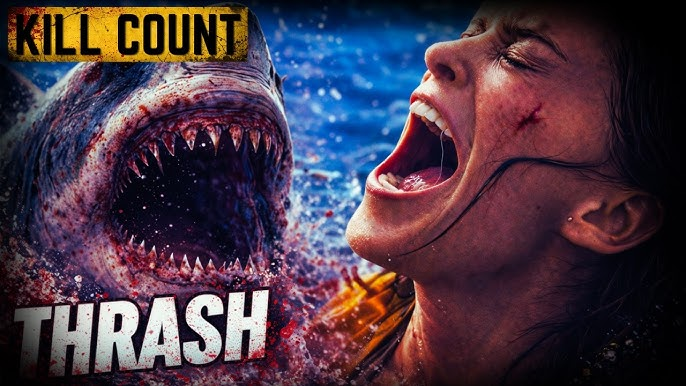
Phoebe Dynevor delivers a performance that is both vulnerable and fiercely determined, grounding the film in raw emotional stakes. Her character doesn’t evolve into a hero in the traditional sense; she survives through instinct, fear, and sheer desperation. It’s this authenticity that makes her journey so gripping—you feel every decision, every hesitation, every breath she takes in a world where one mistake means death.
Djimon Hounsou, as expected, brings a commanding presence that anchors the chaos. His character embodies resilience, but also the quiet understanding that survival is never guaranteed. There’s a weight to his performance, a sense that he has seen the worst humanity—and nature—has to offer, yet still chooses to fight. It’s a subtle but powerful portrayal that elevates the film beyond mere spectacle.
Whitney Peak adds another layer to the narrative, representing a generation caught unprepared in a world unraveling faster than it can comprehend. Her fear feels immediate, unfiltered, and deeply human. Together, the trio forms a fragile alliance, bound not by heroism, but by necessity—a reflection of how survival often strips people down to their most basic instincts.
Visually, Thrash is suffocating in the best possible way. The cinematography traps you within its flooded world, using tight frames, murky water, and limited visibility to create an ever-present sense of dread. You’re not just watching the characters—you’re submerged with them, constantly scanning the water, waiting for something to move.
The sound design deserves particular praise. The distant roar of water, the creaking of collapsing structures, and the almost imperceptible disturbances beneath the surface create an atmosphere that is as terrifying as any visual. Silence becomes a weapon here—because in Thrash, what you don’t hear can be just as deadly as what you do.
What sets this film apart from typical creature features is its psychological tension. The sharks are not overused; instead, their presence lingers like a shadow. The real terror lies in anticipation—in the knowledge that danger is always there, just beneath the surface, unseen but inevitable. It transforms every scene into a test of nerves, both for the characters and the audience.
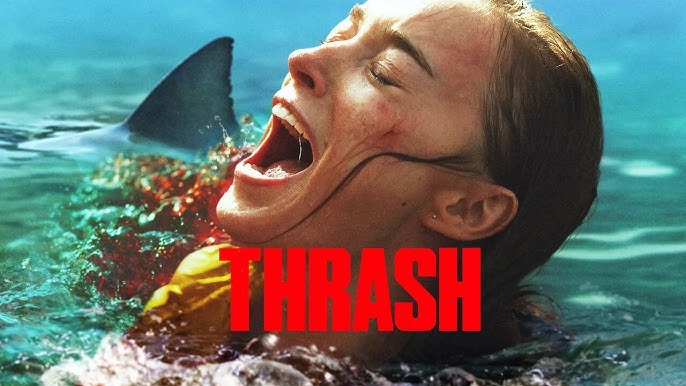
At its core, Thrash is not just about survival—it’s about the illusion of control. The film strips away the comfort of modern life, exposing how fragile our systems truly are when confronted by nature’s indifference. It asks a simple but haunting question: when the world you know disappears overnight, who do you become?
By the time the credits roll, Thrash leaves you with more than adrenaline—it leaves you unsettled. Not because of what you saw, but because of what it suggests. That beneath every calm ocean lies something waiting. That survival is not a guarantee, but a moment-to-moment battle. And most chilling of all—that sometimes, the storm is only the beginning.
